CWE-835:Loop with Unreachable Exit Condition ('Infinite Loop')
Weakness ID:835
Version:v4.17
Weakness Name:Loop with Unreachable Exit Condition ('Infinite Loop')
Vulnerability Mapping:Allowed
Abstraction:Base
Structure:Simple
Status:Incomplete
Likelihood of Exploit:
▼Description
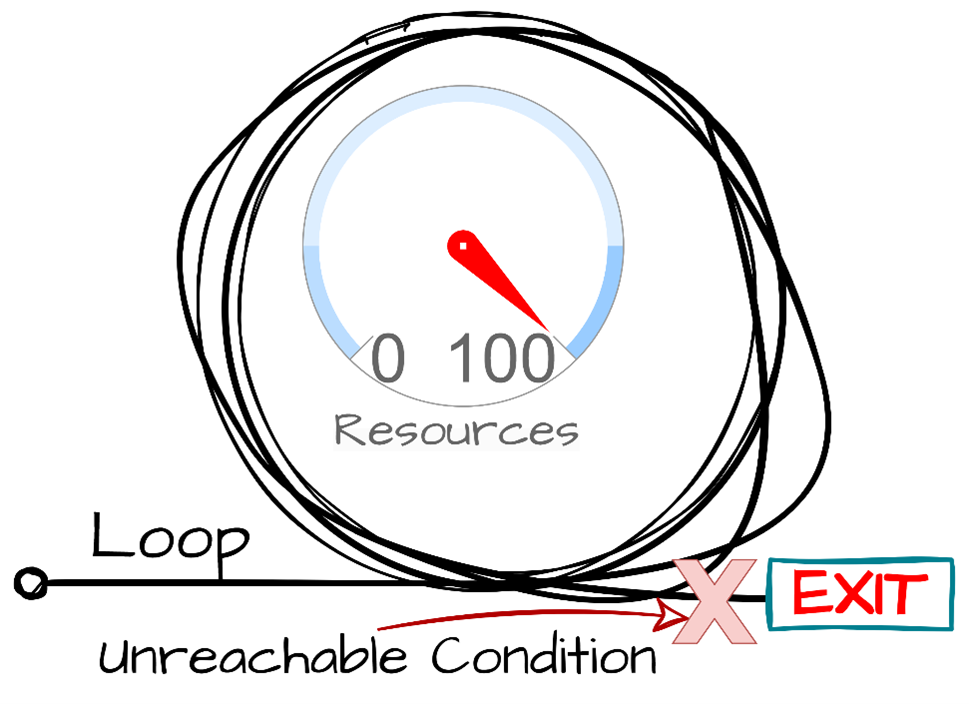
The product contains an iteration or loop with an exit condition that cannot be reached, i.e., an infinite loop.
▼Extended Description
▼Alternate Terms
▼Relationships
Relevant to the view"Research Concepts - (1000)"
| Nature | Mapping | Type | ID | Name |
|---|---|---|---|---|
| ChildOf | Discouraged | C | 834 | Excessive Iteration |
| ParentOf | Allowed | B | 1322 | Use of Blocking Code in Single-threaded, Non-blocking Context |
Nature: ParentOf
Mapping: Allowed
Type: Base
ID: 1322
▼Memberships
| Nature | Mapping | Type | ID | Name |
|---|---|---|---|---|
| MemberOf | Prohibited | C | 438 | Behavioral Problems |
| MemberOf | Prohibited | V | 884 | CWE Cross-section |
| MemberOf | Prohibited | C | 1131 | CISQ Quality Measures (2016) - Security |
| MemberOf | Prohibited | C | 1306 | CISQ Quality Measures - Reliability |
| MemberOf | Prohibited | C | 1308 | CISQ Quality Measures - Security |
| MemberOf | Prohibited | C | 1410 | Comprehensive Categorization: Insufficient Control Flow Management |
Nature: MemberOf
Mapping: Prohibited
Type:Category
ID: 1131
Nature: MemberOf
Mapping: Prohibited
Type:Category
ID: 1410
▼Tags
| Nature | Mapping | Type | ID | Name |
|---|---|---|---|---|
| MemberOf | Prohibited | BS | BOSS-294 | Not Language-Specific Weaknesses |
| MemberOf | Prohibited | BS | BOSS-314 | DoS: Resource Consumption (CPU) (impact) |
| MemberOf | Prohibited | BS | BOSS-321 | DoS: Amplification (impact) |
| MemberOf | Prohibited | BS | BOSS-327 | DoS: Resource Consumption (Memory) (impact) |
Nature: MemberOf
Mapping: Prohibited
Type:BOSSView
ID: BOSS-314
Nature: MemberOf
Mapping: Prohibited
Type:BOSSView
ID: BOSS-327
▼Relevant To View
Relevant to the view"Software Development - (699)"
| Nature | Mapping | Type | ID | Name |
|---|---|---|---|---|
| MemberOf | Prohibited | C | 438 | Behavioral Problems |
Relevant to the view"CISQ Quality Measures (2020) - (1305)"
| Nature | Mapping | Type | ID | Name |
|---|---|---|---|---|
| MemberOf | Prohibited | C | 1306 | CISQ Quality Measures - Reliability |
Relevant to the view"CISQ Quality Measures (2020) - (1305)"
| Nature | Mapping | Type | ID | Name |
|---|---|---|---|---|
| MemberOf | Prohibited | C | 1308 | CISQ Quality Measures - Security |
▼Background Detail
▼Common Consequences
| Scope | Likelihood | Impact | Note |
|---|---|---|---|
| Availability | N/A | DoS: Resource Consumption (CPU)DoS: Resource Consumption (Memory)DoS: Amplification | An infinite loop will cause unexpected consumption of resources, such as CPU cycles or memory. The software's operation may slow down, or cause a long time to respond. |
Scope: Availability
Likelihood: N/A
Impact: DoS: Resource Consumption (CPU), DoS: Resource Consumption (Memory), DoS: Amplification
Note:
An infinite loop will cause unexpected consumption of resources, such as CPU cycles or memory. The software's operation may slow down, or cause a long time to respond.
▼Potential Mitigations
▼Modes Of Introduction
▼Applicable Platforms
Languages
Class: Not Language-Specific(Undetermined Prevalence)
▼Demonstrative Examples
Example 1
In the following code the method processMessagesFromServer attempts to establish a connection to a server and read and process messages from the server. The method uses a do/while loop to continue trying to establish the connection to the server when an attempt fails.
Language: ( code)
N/A
Language: C(Bad code)
int processMessagesFromServer(char *hostaddr, int port) {
...
int servsock;
int connected;
struct sockaddr_in servaddr;
// create socket to connect to server*
servsock = socket( AF_INET, SOCK_STREAM, 0);
memset( &servaddr, 0, sizeof(servaddr));
servaddr.sin_family = AF_INET;
servaddr.sin_port = htons(port);
servaddr.sin_addr.s_addr = inet_addr(hostaddr);
do {
// establish connection to server*
connected = connect(servsock, (struct sockaddr *)&servaddr, sizeof(servaddr));
*// if connected then read and process messages from server*
if (connected > -1) {
// read and process messages*
...}
*// keep trying to establish connection to the server*
} while (connected < 0);
*// close socket and return success or failure*
...}
Language: ( code)
N/A
However, this will create an infinite loop if the server does not respond. This infinite loop will consume system resources and can be used to create a denial of service attack. To resolve this a counter should be used to limit the number of attempts to establish a connection to the server, as in the following code.
Language: C(Good code)
int processMessagesFromServer(char *hostaddr, int port) {
...
// initialize number of attempts counter*
int count = 0;
do {
// establish connection to server*
connected = connect(servsock, (struct sockaddr *)&servaddr, sizeof(servaddr));
*// increment counter*
count++;
*// if connected then read and process messages from server*
if (connected > -1) {
// read and process messages*
...}
*// keep trying to establish connection to the server*
*// up to a maximum number of attempts*
} while (connected < 0 && count < MAX_ATTEMPTS);
*// close socket and return success or failure*
...}
Example 2
For this example, the method isReorderNeeded is part of a bookstore application that determines if a particular book needs to be reordered based on the current inventory count and the rate at which the book is being sold.
Language: ( code)
N/A
Language: Java(Bad code)
public boolean isReorderNeeded(String bookISBN, int rateSold) {
boolean isReorder = false;
int minimumCount = 10;
int days = 0;
// get inventory count for book*
int inventoryCount = inventory.getIventoryCount(bookISBN);
*// find number of days until inventory count reaches minimum*
while (inventoryCount > minimumCount) {
inventoryCount = inventoryCount - rateSold;
days++;
}
// if number of days within reorder timeframe*
*// set reorder return boolean to true*
if (days > 0 && days < 5) {
isReorder = true;
}
return isReorder;
}
Language: ( code)
N/A
However, the while loop will become an infinite loop if the rateSold input parameter has a value of zero since the inventoryCount will never fall below the minimumCount. In this case the input parameter should be validated to ensure that a value of zero does not cause an infinite loop, as in the following code.
Language: Java(Good code)
public boolean isReorderNeeded(String bookISBN, int rateSold) {
...
// validate rateSold variable*
if (rateSold < 1) {
return isReorder;
}
...
}
▼Observed Examples
| Reference | Description |
|---|---|
| CVE-2022-22224 | Chain: an operating system does not properly process malformed Open Shortest Path First (OSPF) Type/Length/Value Identifiers (TLV) (CWE-703), which can cause the process to enter an infinite loop (CWE-835) |
| CVE-2022-25304 | A Python machine communication platform did not account for receiving a malformed packet with a null size, causing the receiving function to never update the message buffer and be caught in an infinite loop. |
| CVE-2011-1027 | Chain: off-by-one error (CWE-193) leads to infinite loop (CWE-835) using invalid hex-encoded characters. |
| CVE-2011-1142 | Chain: self-referential values in recursive definitions lead to infinite loop. |
| CVE-2011-1002 | NULL UDP packet is never cleared from a queue, leading to infinite loop. |
| CVE-2006-6499 | Chain: web browser crashes due to infinite loop - "bad looping logic [that relies on] floating point math [CWE-1339] to exit the loop [CWE-835]" |
| CVE-2010-4476 | Floating point conversion routine cycles back and forth between two different values. |
| CVE-2010-4645 | Floating point conversion routine cycles back and forth between two different values. |
| CVE-2010-2534 | Chain: improperly clearing a pointer in a linked list leads to infinite loop. |
| CVE-2013-1591 | Chain: an integer overflow (CWE-190) in the image size calculation causes an infinite loop (CWE-835) which sequentially allocates buffers without limits (CWE-1325) until the stack is full. |
| CVE-2008-3688 | Chain: A denial of service may be caused by an uninitialized variable (CWE-457) allowing an infinite loop (CWE-835) resulting from a connection to an unresponsive server. |
Reference: CVE-2022-22224
Description:
Chain: an operating system does not properly process malformed Open Shortest Path First (OSPF) Type/Length/Value Identifiers (TLV) (CWE-703), which can cause the process to enter an infinite loop (CWE-835)
Reference: CVE-2022-25304
Description:
A Python machine communication platform did not account for receiving a malformed packet with a null size, causing the receiving function to never update the message buffer and be caught in an infinite loop.
Reference: CVE-2011-1027
Description:
Chain: off-by-one error (CWE-193) leads to infinite loop (CWE-835) using invalid hex-encoded characters.
Reference: CVE-2011-1142
Description:
Chain: self-referential values in recursive definitions lead to infinite loop.
Reference: CVE-2011-1002
Description:
NULL UDP packet is never cleared from a queue, leading to infinite loop.
Reference: CVE-2006-6499
Description:
Chain: web browser crashes due to infinite loop - "bad looping logic [that relies on] floating point math [CWE-1339] to exit the loop [CWE-835]"
Reference: CVE-2010-4476
Description:
Floating point conversion routine cycles back and forth between two different values.
Reference: CVE-2010-4645
Description:
Floating point conversion routine cycles back and forth between two different values.
Reference: CVE-2010-2534
Description:
Chain: improperly clearing a pointer in a linked list leads to infinite loop.
Reference: CVE-2013-1591
Description:
Chain: an integer overflow (CWE-190) in the image size calculation causes an infinite loop (CWE-835) which sequentially allocates buffers without limits (CWE-1325) until the stack is full.
Reference: CVE-2008-3688
Description:
Chain: A denial of service may be caused by an uninitialized variable (CWE-457) allowing an infinite loop (CWE-835) resulting from a connection to an unresponsive server.
▼Affected Resources
▼Functional Areas
▼Weakness Ordinalities
| Ordinality | Description |
|---|
▼Detection Methods
▼Vulnerability Mapping Notes
Usage:Allowed
Reason:Acceptable-Use
Rationale:
This CWE entry is at the Base level of abstraction, which is a preferred level of abstraction for mapping to the root causes of vulnerabilities.
Comments:
Carefully read both the name and description to ensure that this mapping is an appropriate fit. Do not try to 'force' a mapping to a lower-level Base/Variant simply to comply with this preferred level of abstraction.
Suggestions:
▼Notes
▼Taxonomy Mappings
| Taxonomy Name | Entry ID | Fit | Entry Name |
|---|---|---|---|
| OMG ASCSM | ASCSM-CWE-835 | N/A | N/A |
Taxonomy Name: OMG ASCSM
Entry ID: ASCSM-CWE-835
Fit: N/A
Entry Name: N/A
▼Related Attack Patterns
| ID | Name |
|---|
▼References
Reference ID: REF-62
Title: The Art of Software Security Assessment
Author: Mark Dowd, John McDonald, Justin Schuh
Section: Chapter 7, "Looping Constructs", Page 327
Publication:
Publisher:Addison Wesley
Edition:1st Edition
URL:
URL Date:
Day:N/A
Month:N/A
Year:2006
Reference ID: REF-962
Title: Automated Source Code Security Measure (ASCSM)
Author: Object Management Group (OMG)
Section: ASCSM-CWE-835
Publication:
Details not found